theatre

The Fall of Albion
Synopsis

“I enjoyed it enormously.  I particularly admired the originality of style.”
Andre Gregory, Actor and Director, on The Fall of Albion

screenshot 2025 12 20 191018

The Fall of Albion is based on a famous event in Greek mythology:
the usurpation of the Delphi Oracle of Gaia–Mother Earth–by the
invading god Apollo, and the subsequent transformation of Greek
culture from a feminine, mystical, static matriarchy into the
masculine, warlike, advancing people of the Illiad and Odyssey. T
he resulting state of war between the old earth goddesses and the new
Olympic pantheon constitutes the central conflict of the play.

 The play is set in Albion, between the World Wars, as the battle
continues for the souls of men. The action of the play produces a
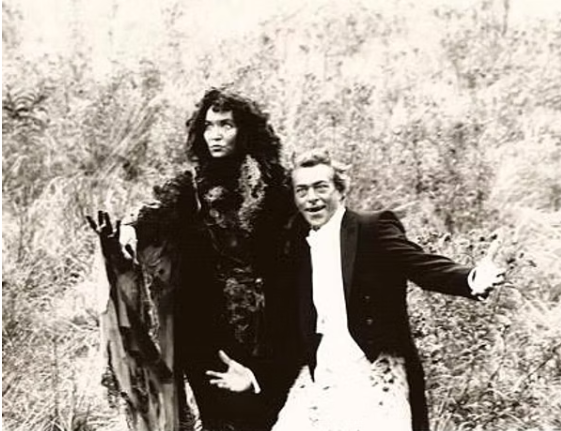
tragedy for the mortals, and a comedy for the gods. Apollyon, the
central figure in the play, is a demi-god,
a reaper of souls in Herme’s entourage, a task he performs with
apparently immoral delight. He ‘flies’ around the
theatre on a crane, sings of his ribald conquests, and finally settles on a
prominent family in Albion, weaving a           
w
eb of treachery for no greater purpose
than the conquest of an innocent woman,
Anne. The monstrous Furies, with dog
faces, bat wings, and snakes for hair, watch
it all happen with increasing outrage from
the spirit world, until at last they invade
the mortal plane to attack Apollyon, beat him
to a pulp, and watch him explode in bloody
humiliation.

screenshot 2025 12 20 191900

Characters in the spirit world are shown as projections on a screen at the back of the stage. Six of the eleven characters
in the play appear as such spirits–gods, goddesses, or departed souls–reciting their lines to a backstage camera, which
then projects their images, transforming them into two dimensional beings–alive, transparent, disembodied–that can
suddenly expand into faces ten feet tall or slowly dissolve into a point of light. The relationship between the projected
spirit world on screen and the mortal plane on stage is an important elementin the play. The gods are free to cross the boundary
at will, a feat which the mortals can only accomplish in death.

The play calls for eight actors–three men and five women–four of them mortals, four gods. The god Apollyon also plays three
mortal roles in disguise, making eleven characters in all. About half the play is set to music, with some fifteen set pieces, mostly
patter style, with substantial underscoring of the dialogue as well. The gods do nearly all the singing. The music can be produced by
as few as three or as many as ten musicians, depending on resources. The language runs from conventional prose in parts of the
dialogue, to blank verse in the heightened underscoring, to rhymed couplets in the set pieces. Taken all together, projections, crane
flights, drama, musical set pieces and underscoring will produce a kind of cinematic theatre, in which elements of film, theatre, opera, and even the circus
are combined.


LISTEN
::click below to listen::
 
 
The Fall of Albion
Beware of Apollo
ACCOLADES
::click below to read::